To millions online, Johnny Huynh is already a familiar face: the Seattle-born, Los Angeles-based Vietnamese-American singer whose emotionally vulnerable covers helped launch a fast-rising music career. At the time of writing, he has nearly 13 million followers across Instagram and TikTok, a digital-age ascent that feels distinctly Bieber-esque: a young singer posts covers online, amasses an enormous audience, and begins the transition from internet personality to legitimate pop act. But HEAVEN’S ON FIRE (2026), his debut album, suggests something more personal than the standard influencer-to-musician pivot.
“This past year, I’ve gone through heartbreak. I found true love. I lost a family member. I’ve learned what it means to grow up,” he says. “I didn’t realize while writing this album how emotional the process would be. It became such a healing process for me too, and I think that’s what’s been connecting with people, because everything feels very raw.”
Huynh’s musical story began far from social media. Raised in a Buddhist Vietnamese household in Seattle, he attended Vietnamese language school, spent time at temple, and performed traditional Vietnamese songs alongside his two older brothers at community fundraisers. Long before he thought of himself as a pop artist, music was simply part of the atmosphere of home.
“Me and my two older brothers kind of played in like a ‘Jonas Brothers’ type of group when I was like seven through twelve,” he says, laughing. “We did fundraisers for the local Vietnamese community, and that really helped me connect music and culture together. I learned how to sing a lot of traditional Vietnamese songs, and I think that’s always been in the back of my mind while making music.”

That foundation was paired with a far more conventional kind of discipline. Huynh trained in classical piano and pursued the sort of stable academic path familiar to many children of immigrant households, eventually earning a degree in mechanical engineering. Even now, he speaks less like an erratic young pop hopeful than someone shaped by routine, structure, and relentless work ethic.
“I still got my degree in mechanical engineering,” he says. “I still wake up early every morning. I try to fill out my schedule as much as possible. My parents really gave me that work ethic. In entertainment, you need that.”
For a time, the plan pointed somewhere far from music. Before pursuing pop full-time, Huynh was interning at SpaceX, building toward a future in engineering rather than performance, until a friend suggested he try posting his voice online.
“My best friend was like, ‘You have a really good voice. You should start posting on TikTok,’” he says. “I was doing a mechanical engineering internship at SpaceX, and after work I had nothing to do. So I just put the camera down and started singing. Within the first two weeks, my account started blowing up, and everyone really liked my voice. From there, I thought, okay, let me keep doing this.”
Plenty of internet-born creators find a formula and spend years repeating it. Huynh instead became interested in authorship, production, and building something that could outlast the algorithm, eventually making the leap to Columbia Records—a far rarer transition than virality alone might suggest.
“I never had any intention to do music full-time,” he says. “But I fell in love with music production. I bought all these programs and started learning how to produce by myself. Then when I moved to LA, the connections I made really pushed my career way farther—meeting management, getting an agency, signing to a record label.”

The record label in question is Columbia, which changes the stakes considerably. Internet fame and music careers are not remotely the same thing, and while plenty of creators build audiences, far fewer make the leap to a major label where the expectations shift from visibility to viability. A cover can prove that people like your voice; a debut album asks whether they care about your interior life. That is the actual test of HEAVEN’S ON FIRE, a record that trades borrowed emotion for self-authored confession.
When you’re putting together an album, you really want to tell a story. I feel like I totally changed who I am as a person.
The music lives squarely in what Huynh describes as dark pop, though what he means is less rigid genre classification than emotional atmosphere. The songs are cinematic, dramatic, and emotionally oversized in a way that rejects understatement. Tracks like Bleed My Love lean into obsessive intensity, while the danceable Oxygen feels like emotional freefall disguised as release.
“It’s kind of this blend of pop and R&B and ballads,” he says. “There’s that sexiness to it as well. It’s not just regular pop. I’ve really been going for the cinematic side of things, because my voice is naturally very strong and belty, and I feel like that works really well with bigger production. But I’ve also challenged myself because I don’t want to box myself into one style.”
That ambition also places him in an unusual lane within American pop. Asian artists are more visible than ever, but often within ecosystems audiences already know how to categorize, particularly K-pop and R&B. Huynh is fully aware that a Vietnamese-American male artist attempting broader mainstream pop still feels uncommon.
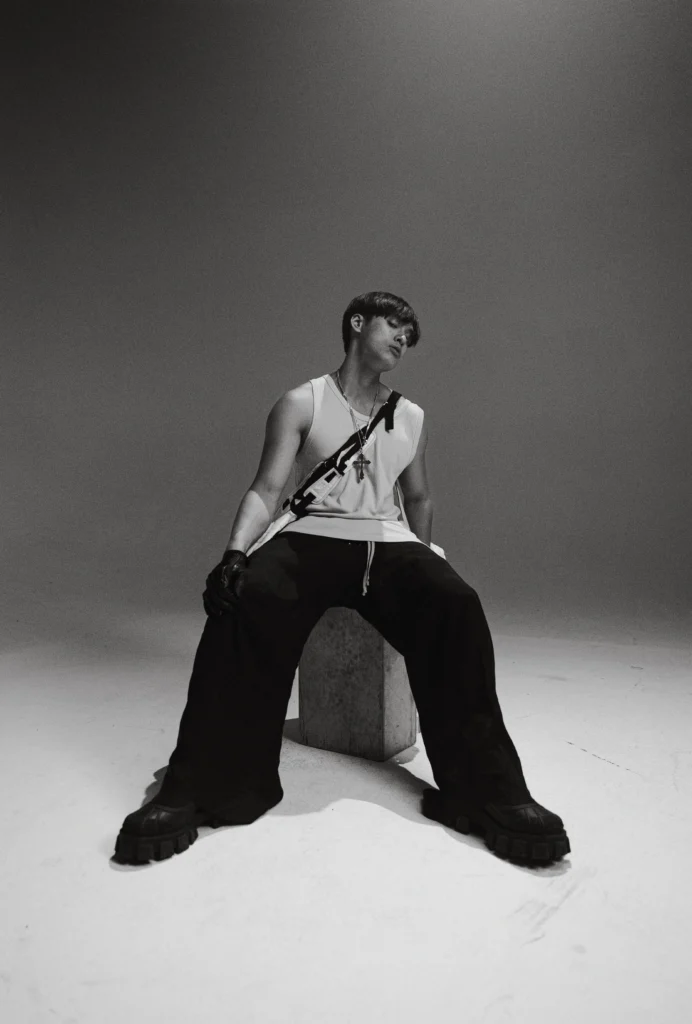
“If we look at American pop right now, there’s not really an Asian voice doing this that isn’t K-pop or R&B,” he says. “A lot of people who look like me are often involved in those scenes, and I feel like I’m trying to break into something different.”
For all his ambitions to break outside the lanes often assigned to Asian-American artists, Huynh remains deeply connected to his Vietnamese identity. It surfaces in the music not as branding, but as something instinctive and lived, particularly in the sonic details.
“In Oxygen, we added this weird violin-type solo thing at the end,” he says. “I feel like I hear sounds like that a lot in traditional Vietnamese music. Sometimes they have these more unusual instruments that aren’t really in traditional American music. I don’t want to make music that sounds exactly like classic American pop. I want people to hear something and think, oh, Johnny has some culture and some depth.”
The emotional center of the album, however, is Ghost in the Mirror, which Huynh says was the hardest song to write. The track emerged after the death of his grandmother in Vietnam late last year, touching on a dynamic many diaspora families will immediately recognize: closeness shaped by distance.
“When I hear my friends say they’re going over to their grandparents’ house, I think about how different that is,” he says. “When your grandparents are in Vietnam and you’re over here, even if you call every day, it’s not the same. When she passed away, I realized that opportunity for a deeper relationship was just gone.”

Huynh describes growing up in a home where photos of deceased relatives remain visible throughout the house, less memorial than spiritual continuity. That emotional framework gives HEAVEN’S ON FIRE a specificity that feels richer than generic heartbreak songwriting, grounding its heartbreak in something more personal than romantic melodrama.
“We kind of have pictures of the people who have passed all over the house,” he says, referencing the traditional ancestor altars Vietnamese people often keep at home. “You kind of feel their energy around you.”
That connection to Vietnam remains unfinished in more literal ways, too. Huynh last visited the country when he was seven and remembers very little, but returning now as an artist feels increasingly plausible. Unsurprisingly, Vietnam sits near the top of his dream touring list.
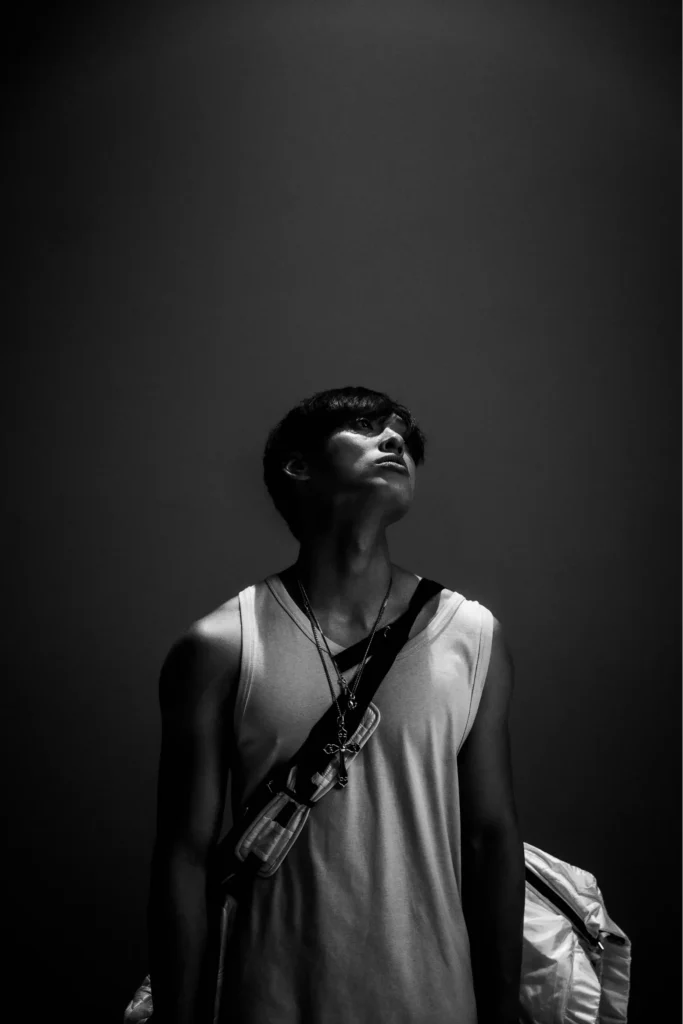
“My biggest goal is to do an international headline tour,” he says. “Vietnam, the Philippines, Indonesia. I know I have a huge fanbase there, and being able to give back to the culture that I learned so much from would be such a huge goal of mine.”For someone who arrived through the internet, HEAVEN’S ON FIRE feels surprisingly intimate: a record less concerned with pursuing virality than addressing unfinished emotional business. Viral fame may have introduced Johnny Huynh to the world, but this record suggests he is finally introducing himself.
Images courtesy of Bryant Hyun