When we catch up with Van-Anh Nguyen, she is rehearsing for her Valentine’s Day concert at Quán Bụi. Later that evening, her Valentine—her partner and the other half of the melodic house duo Double Touch, Mark Olsen—will step behind the DJ decks. For now, he is adjusting the setup, moving chairs, checking cables, while she runs passages at the keyboard. We are here to talk about her first love: the piano.
Nguyen introduces herself plainly as a “concert pianist, composer, and music producer,” a description that barely contains the scope of her career. An ARIA-nominated recording artist signed to Universal’s classical imprints, she became the first Australian-Vietnamese musician to enter the US iTunes Classical Charts and has performed as a soloist with the Boston Pops Orchestra under Keith Lockhart. Ten albums span major platforms; her stages have ranged from the Sydney Opera House to concert halls across Asia and the United States. For Nguyen, it feels perhaps like destiny.
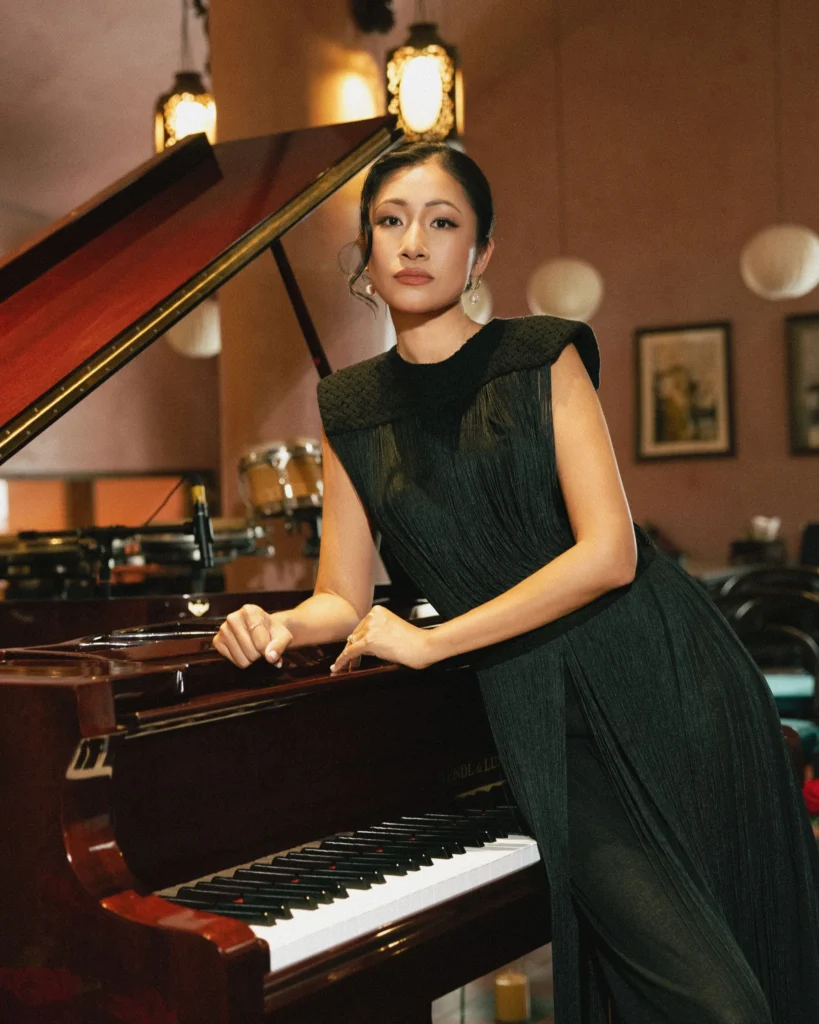
I think it was always in my blood. My mum was singing opera recitals while she was pregnant with me, so I was already absorbing it.
Her parents were classically trained at the Saigon Conservatory before leaving Vietnam in 1984 and eventually settling in Australia, where Nguyen was born and raised. Her mother was an opera singer; her father, a classical guitarist who later taught. Music was not extracurricular but structural. “In Vietnamese, we say con nhà nòi,” she says, laughing. “It’s like being a ‘nepo baby’—but not really. I was just surrounded by it my whole life.”
There was little doubt she would pursue music, even as her parents understood the precarity of the profession. “Every parent wants financial stability for their child,” she says. “They know how hard it is to be a musician. My mum would say, at least teach—that’s stable. And I’d say, I can teach later. What actually sparks joy for me is being on stage and sharing the piano.”

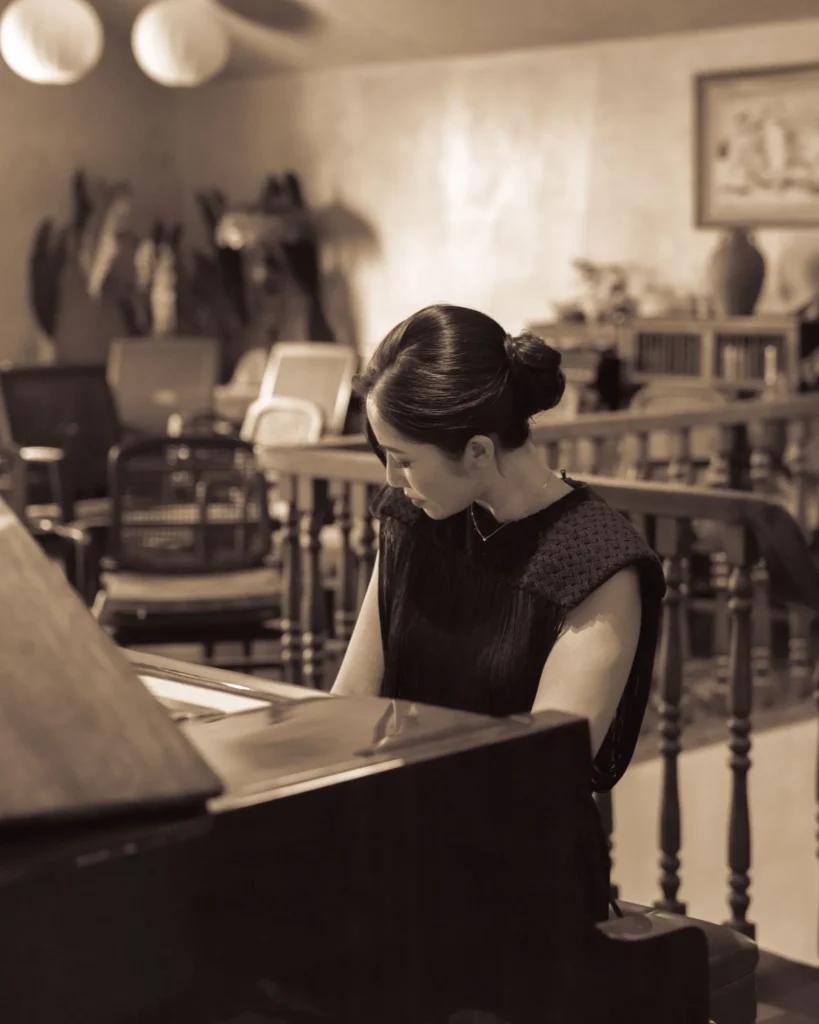
She began lessons at 13 months old and debuted at the Sydney Opera House at eight. Formal training at the Sydney Conservatorium followed, along with masterclasses in Europe and the United States. The early years were devoted to core repertoire—the canonical works that define classical discipline—while recording became equally central to her thinking. “Recording is our legacy,” she says. “It’s something people can return to. In the end, it’s an incredible business card.”
Before signing to a major label, she self-released nine albums rooted in traditional solo piano repertoire. The shift came when she began questioning audience access. “I wanted to bridge the gap,” she says, “between older classical audiences and younger people who are curious but don’t know how to enter that world.” Her answer was synthesis. “It’s about mashing genres together.”

That instinct led to Pop Alchemy, blending classical composition with contemporary pop structures and treating genre boundaries as permeable rather than fixed. She initially planned to release it independently. “I was going to put it out myself,” she recalls. “I pitched it around almost as a formality. Then Universal said, ‘Stop. We’re taking this.’” She signed in 2018, and the album became her first major-label release in January 2019.
The highlight of my career is still performing. That hunger to play new places and have that opportunity—that’s what drives me.
She resists framing that moment as a climax. “When you’re young, you have bucket-list concert halls or dream labels,” she says. “Then you get there and think, okay—what next?” The industry has shifted, and milestones no longer guarantee permanence. “For me, the highlight of my career is still performing,” she says. “That hunger to play new places and have that opportunity—that’s what drives me.”

Her move into electronic music felt like a natural next step. She met Olsen in a Sydney studio around 2015, and music preceded romance. “I’ve always loved house music,” she says. “So I thought, why not write house—but blend orchestral melody with house beats?”
Double Touch formed organically. “We were just enjoying writing music. We never thought that we’d build a career together.” Releases through melodic house labels built momentum, and international festivals followed. Then the pandemic halted touring. “We couldn’t tour, but we had time to write,” she says. “People were listening differently in 2020 and 2021. They actually had time.” By the time live shows resumed, a global audience had already formed online.

Her Valentine’s Day concert reflects that duality. The program moves from classical foundations to pop and film music, framed through narrative rather than strict formality. “You can’t expect someone who’s never heard classical music to sit through a 40-minute sonata in silence,” she says. “Without context or storytelling, how are they meant to process it?” After the piano set, the room will shift as Olsen takes over the DJ booth, extending the arc into a different tempo. “If I can do both in one night,” she says, smiling, “that’s completely fulfilling.”
I know when not to play; he knows when to step in. After nearly ten years, it’s unspoken.
Now, working and touring together sharpens both craft and candor for the couple, with this Saigon performance wedged between sold-out gigs in New Zealand and Sri Lanka. “We’re brutally honest,” she says of their studio process. “If something sounds bad, we say it. It’s never personal—it’s about making the track better.” Onstage, the communication is largely wordless. “We understand each other’s ebb and flow,” she says. “I know when not to play; he knows when to step in. After nearly ten years, it’s unspoken.”

With a career defined by crossing over—Australia and Vietnam, conservatory and club, classical and electronic—Vietnam now feels less like a return and more like an active chapter. She has been coming back since 1994, watching the country shift in texture and tempo.
“I was raised in a way where the Vietnamese culture has been so strong in our family,” she says. “Some families assimilate and lose the language, but that was never the case with us. It was always the traditions, speaking Vietnamese, writing emails to my uncles and aunts. It was ingrained in me.”
That continuity shapes how she sees her role here. Music, she insists, is a universal language, but infrastructure and access are not. Classical music remains a developing ecosystem in Vietnam, one that requires participation rather than passive admiration. She notices the change in audiences—the curiosity, the willingness to experiment, the appetite for hybrid formats that might once have felt irreverent.

“Right now, I can just see the openness and people are curious,” she says, describing a generation less concerned with rigid definitions than with experience, though she believes exposure alone is not enough. “How is an 8-year-old or a 15-year-old, or a 25-year-old who has never experienced classical music meant to process that without some sort of storytelling?”
For Nguyen, context is the bridge. Before she plays, she explains why a composer wrote a piece, what emotional rupture or longing shaped it, and how that arc unfolds structurally, turning a sonata from a technical exercise into a narrative of tension and release. “The way to express it on the piano is through sound and through storytelling—through sound without words,” she says, framing programs around themes like love to give audiences an emotional anchor across eras.
That philosophy extends beyond a single concert and toward a broader responsibility in Vietnam. “Classical music, I think, is still growing here,” she says. “But if we don’t contribute to it or we don’t engage with the musicians here, I think it’s our duty to.”
Photographer: Tân Anh Vico