On the western bank of the Chao Phraya River, the bells of St. Francis Xavier Church cut through the humidity. The façade is European, the river unmistakably Thai—and yet inside, Vietnamese surnames fill the parish books. Some trace their lineage back nearly two centuries, to a different river entirely.
In the 1830s, amid shifting political currents in the Nguyễn court, families from central Vietnam made their way westward. They crossed into Siam, where the royal court granted them refuge and land along the riverbanks of what was then a growing capital.
What began as exile became settlement, what began as survival became inheritance. They formed what would come to be known as Ban Yuan — literally, “the Vietnamese village.” For nearly 200 years, Vietnamese has been spoken here alongside Thai.
We tend to tell the Vietnamese diaspora story through 1975 — boats, rupture, aftermath. Ban Yuan unsettles that version. Long before “diaspora” became political shorthand, Vietnamese communities were already embedding themselves into foreign capitals and Bangkok was one of them.
If the church preserves memory in ink, the market preserves it in steam
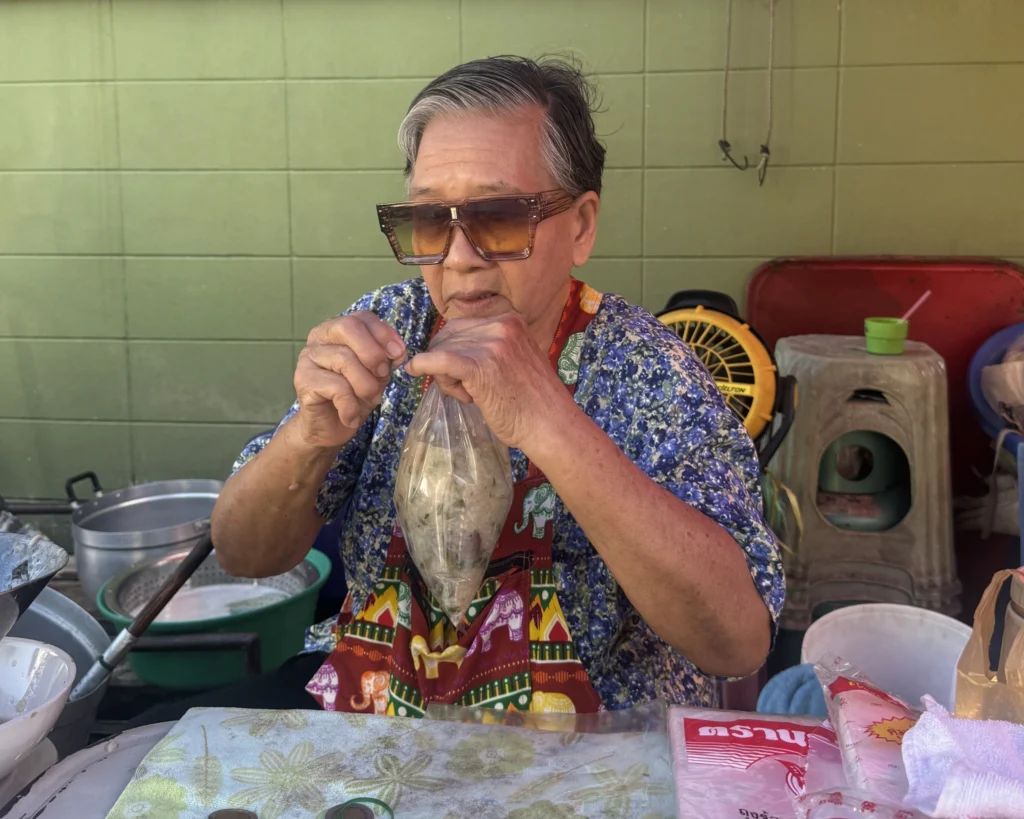
A few streets from the river, the air thickens with rice batter and charcoal. A thin sheet is spread over taut cloth stretched above boiling water, lifted with practiced fingers, folded around minced pork and mushrooms.
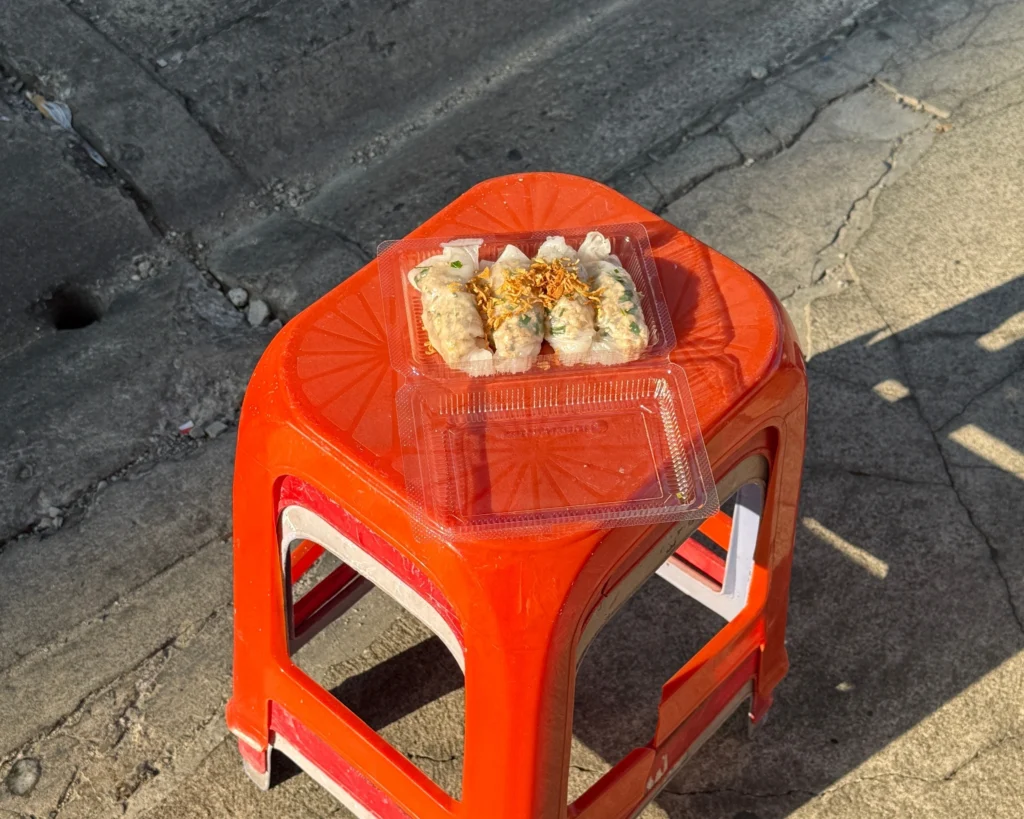
Bánh cuốn appears on a plastic plate in the middle of Bangkok: delicate, translucent and unassuming. Nearby, trays of bánh bèo sit crowned with dried shrimp and scallion oil. Bowls of chè glow in pandan green and mung bean yellow, heavy with coconut milk. These are intimate foods: provincial, Huế foods. The Perfume River may be far from the Chao Phraya, but its culinary grammar lingers here.
Thai basil slips into the herb basket. Sugar leans sweeter. Chilies burn sharper. Climate and time leave their imprint. Yet the structure of the dish remains intact. Nearly two centuries later, the recipe still knows where it began.
Tucked deeper into the neighborhood, behind a modest storefront without fanfare, is Pa Ke Naem Nueang. It feels less like a restaurant and more like someone’s dining room that happens to be open to the public. Printed tablecloths, plastic chairs, faded family photographs and a ceiling fan pushing heavy air in slow circles.
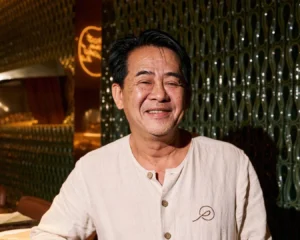
The current owners descend from the early migrants who made Ban Yuan home. When we speak, they move between Thai and Vietnamese with ease—switching mid-sentence, almost unconsciously. The history here is carried in posture, in accent and in the way the kitchen moves.
The nem nướng arrives first: skewers of grilled pork, caramelized at the edges, perfumed with smoke. It comes with a riot of herbs — mint, cilantro, Thai basil — and wide lettuce leaves meant to hold everything together. You tear the leaf, layer the herbs generously, add slices of pork, roll it tight, dip it into fish sauce cut with lime and chili.
The herbs may grow in Thai soil and the sweetness may lean toward Bangkok, but the ritual is unchanged: it is tactile, communal and built by hand. Recipes here are not written down; they live in gesture—in how much herb is “enough,” in the instinctive balance between smoke, salt, sweetness, and heat.
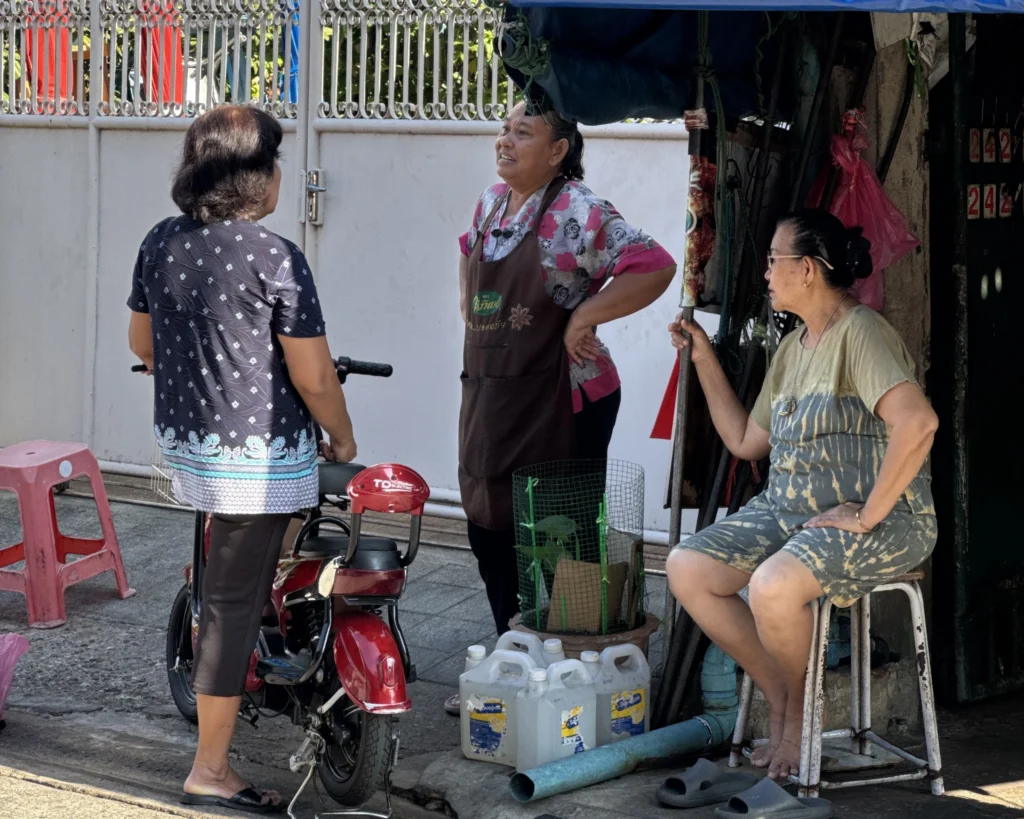
Ban Yuan does not advertise itself as Little Vietnam: there are no decorative gates and no curated plaques. Its history is embedded—in the church registries, in Sunday markets, in kitchens where fish sauce sits beside Thai chili paste without tension.
Walking these streets, what becomes clear is this: Vietnamese communities have long existed everywhere. Paris. Berlin. California. Bangkok. Migration, for Vietnam, has never been a single rupture.
It has been a rhythm—sometimes forced, sometimes chosen but always adaptive. Nearly two centuries after families from Huế crossed into Siam seeking refuge, their descendants still steam rice batter at dawn, still grill pork over charcoal, still layer herbs by instinct. History does not always arrive with monuments, sometimes it survives in the way a dish is folded, rolled, dipped, and passed across a table. In Ban Yuan, that survival feels almost effortless.
Photos: Yen-Nhi Le & Lan Bao Nguyen