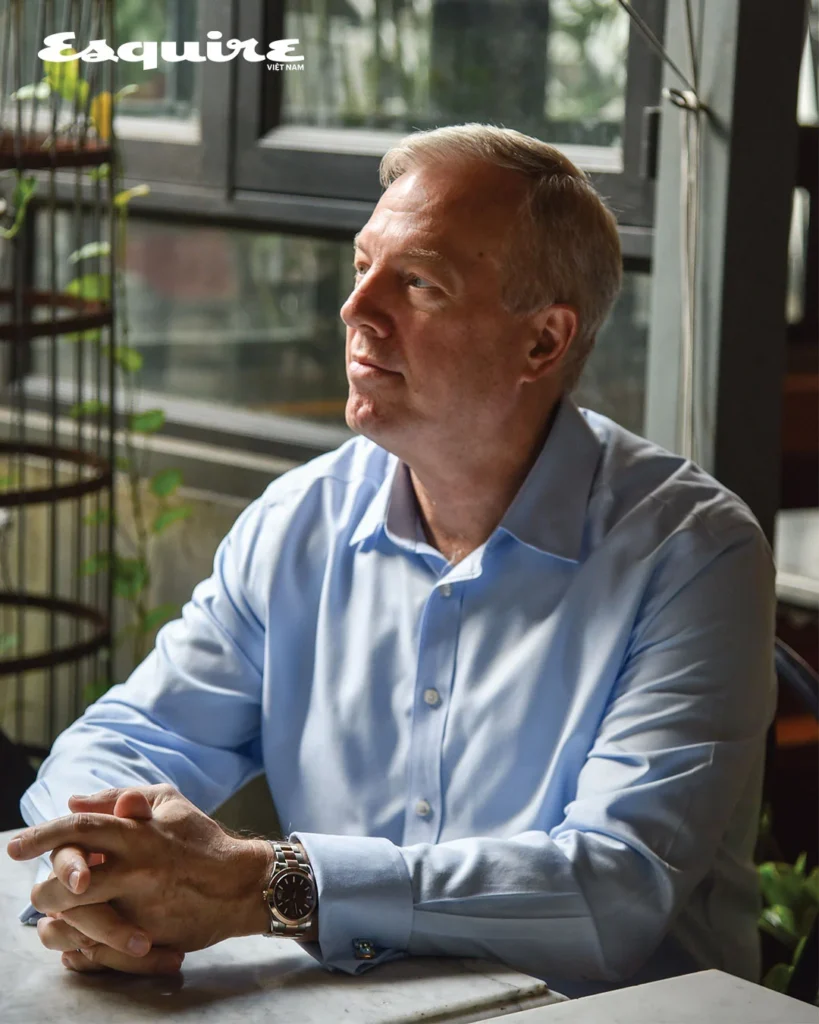
Ted Osius has lived many lives. A career diplomat for nearly three decades, he was in Hanoi in the mid-1990s when the United States and Vietnam first established diplomatic relations. Two decades later, he returned as U.S. Ambassador from 2014 to 2017—the role he still calls his “dream job”. Today, he’s back in Ho Chi Minh City with his husband and two children, serving as Senior Vice President and Regional Managing Director of the US-ASEAN Business Council. Along the way, he’s written a book about reconciliation, biked the length of the country, and helped shape a relationship once thought impossible. Here, in his own words, is what he’s learned.
Serving as U.S. Ambassador to Vietnam was my dream job. I’d been here in the 1990s when we first opened diplomatic relations, and I’d fallen in love with the country—its people, the language, the history, the art, the music. The idea of coming back as America’s representative was something I didn’t think possible, but it turned out it was.
Vietnamese people have taught me resilience—and forgiveness. In Quang Tri, a woman described how her village had been devastated by American bombing. I admitted I was an American diplomat. She looked at me and said, “Hôm nay, mình là chị em”. That spirit of forgiveness I have found in every province of Vietnam.
Reconciliation is possible. Men and women of courage on both sides took enormous risks to make us friends. In the process, we learned about each other’s humanity.
Diplomacy is straightforward. Show respect, build trust, do things together. Without respect you can’t build trust, and without trust you can’t accomplish anything.
The hardest time I faced as ambassador was near the beginning. My counterparts kept saying, “Our General Secretary wants to meet the President in the Oval Office.” Washington said no. I went around the system to John Kerry, who spoke to President Obama. Obama said, “Okay, I’ll do it.” Once Nguyễn Phú Trọng was treated with respect in the Oval Office, the trajectory of the relationship shifted permanently.
Writing a book teaches you persistence. I carried a box of papers from the 1990s all over the world. At the end of my ambassadorship I pulled it out and said, “There’s a story here.” In the end, it was a labor of love—because these stories matter.
Being a visible same-sex couple in Vietnam, we expected resistance. Instead, we found support. People saw we were like any other parents. Sometimes young people even came up to us and said they had come out to their parents once they saw that the U.S. Ambassador could be gay and have a family.
My family feels at home in Ho Chi Minh City. When we landed, my son turned to me and said, “Papa, we’re home.” They have always been warmly welcomed in this country, and so have we.
Parenthood has taught me patience. Kids are challenging, and you have to be patient if you want to be a good parent.
It also taught me about the fierceness of love. There’s no love more ferocious than that of a parent for a child. They’re like your heart outside of your body.
Children deepen a marriage. You have to be unified, because kids learn early on how to manipulate, divide, and conquer.
At 64, I want to live long enough to watch my kids grow up. I work out with a trainer, I try to eat carefully, and I try to get good sleep. When I was younger it was about looking good. Now it’s about being around for my children.
Vietnam has transformed. When I first came in 1996, more than half the population lived under a dollar a day. Now it is one of the fastest-growing economies in the world, and the percentage of people living in poverty is in the single digits.
What strikes me most now is the optimism of Vietnam’s young people. They are engaged with the world, deeply connected, and hopeful about the future.
The next leap for Vietnam will come through innovation. Education has to celebrate critical thinking, creativity, and connection to the world of ideas. The talent is here, the determination is here—now the ecosystem has to catch up.
Image: Richard Le