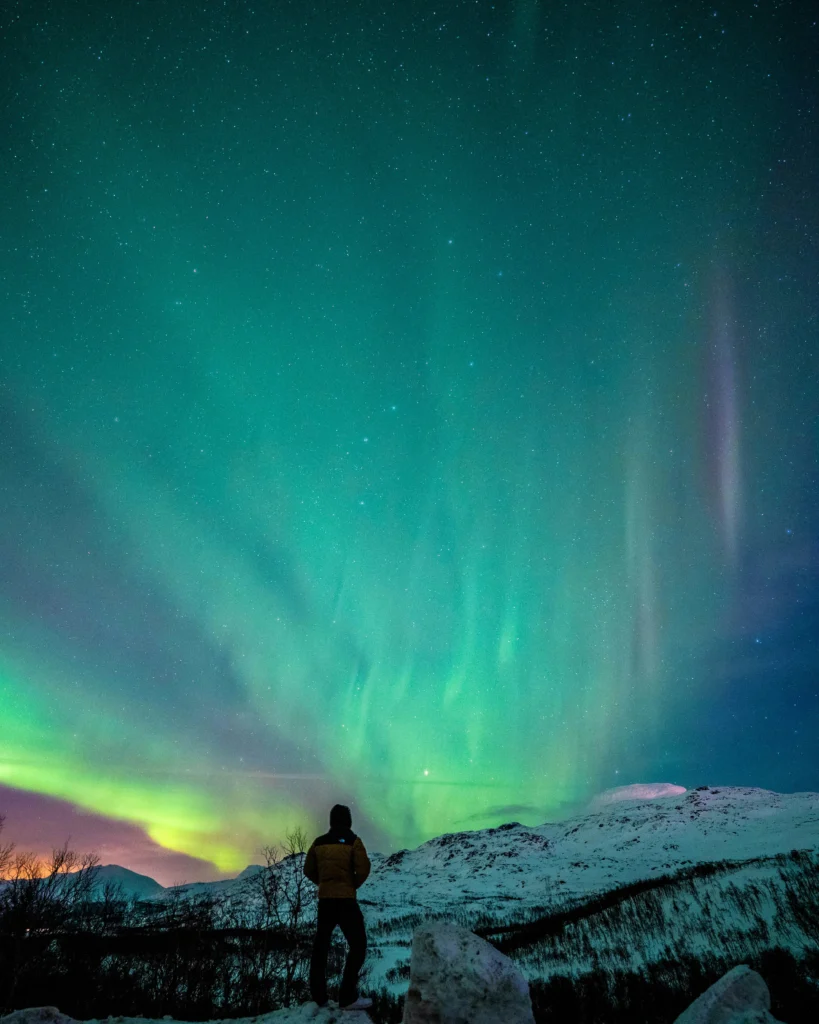
In a past life, during my 20s, when I was a full-time travel writer, I spent three years visiting over 30 countries. My work took me from tiger-spotting safaris in India to long road trips through Chile’s wine country, and out into the Icelandic tundra to see the northern lights. I traveled light. I traveled often. And almost always, I traveled by myself.
Traveling solo forces a certain humility. You take your own photos, or you hand your phone to strangers and trust them to return it. You ask questions you’d otherwise outsource. You sit at bars alone long enough that someone, perhaps the bartender, eventually talks to you. These small, unguarded interactions add up, teaching you how to pause and find common ground where it might not be as obvious.
Many of the connections I made on my trips—at a restaurant, on a tour, and yes, through dating apps—have lasted far longer than the journeys themselves. A few even remain close friends. There was the married couple I met at a New Year’s Eve party in Mustique, a crew of mezcaleros in Oaxaca, and a week-long “fling” I had in San Sebastien. Yet, none of them would have happened if I’d been with a group.
To be clear, this isn’t an argument against shared travel. I love traveling with my family. I love trips with friends that revolve around parties, inside jokes, and stories that only make sense to the people who were there. There’s a time for that kind of joy. But it’s often on my own that I travel most immersively—when I let destinations truly shape me, rather than just wash over me.
Solo travel removes the need to perform. There’s no one to entertain with your outfit, no consensus to reach on a plan, no pressure to check things off a list. You follow your own rhythms—lingering when something holds you, leaving when it doesn’t. In that freedom, you begin to notice subtler things, not just about your surroundings but also yourself. I wouldn’t be the man I am today had I not faced my fears to explore the world alone.
But traveling alone doesn’t mean being lonely. In fact, it often produces the opposite. It opens you up—to people, to places, to versions of yourself that only surface when no one else is watching. That’s why we endorse it. Not as an act of escape or self-discovery, but as the ultimate test of being present. After all, sometimes, the most meaningful company you keep is your own.