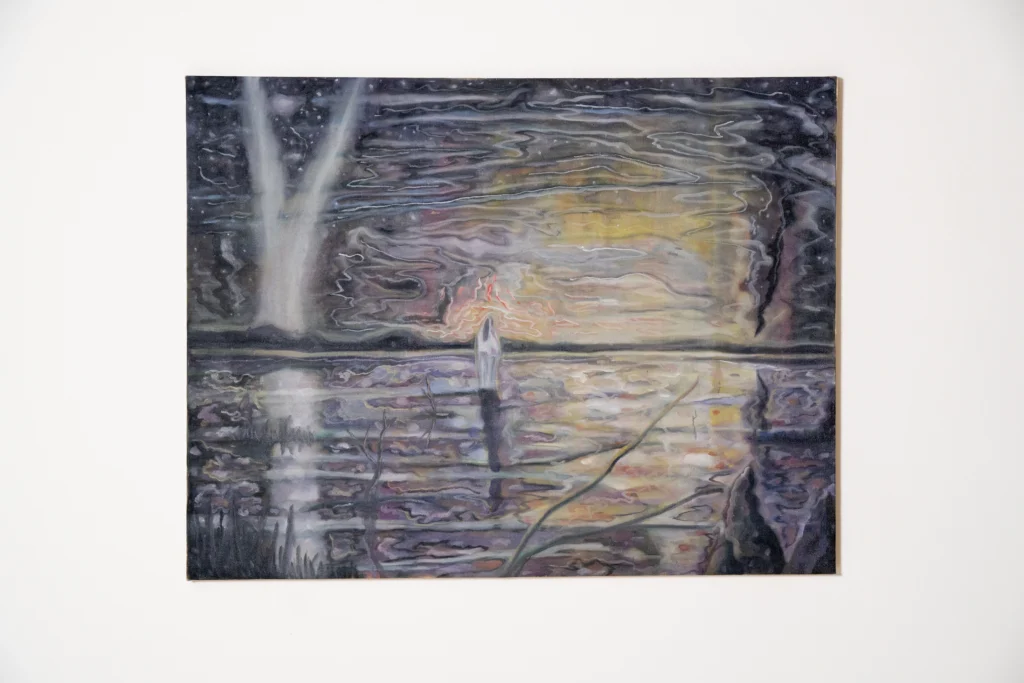
Few qualities in a painting reveal themselves more conspicuously and strikingly than the mark of a deeply contemplative mind. Such is the impression one is left with when encountering the work of Hai Hoang – subdue canvases that reminisce at once of ethereal dreams and plain memories. They constitute a spectral domain that can’t help but arouse curiosity: what realms of consciousness, what lines of inquiry have come to delineate such peculiar landscapes?
In observing the work alongside the artist – uncovering the artistic and intellectual impetuses that govern his practice, the probing underlying these uncanny configurations becomes astoundingly clear. Having spent much time imploring philosophical narratives, Hoang brings to his practice a seamless fusion of rigorous conceptualisation, acute creative intuition, and a deep engagement with pluralistic values and symbols that have been translated into a cohesive visual syntax with effortless sincerity.
Conceiving art in humanist terms
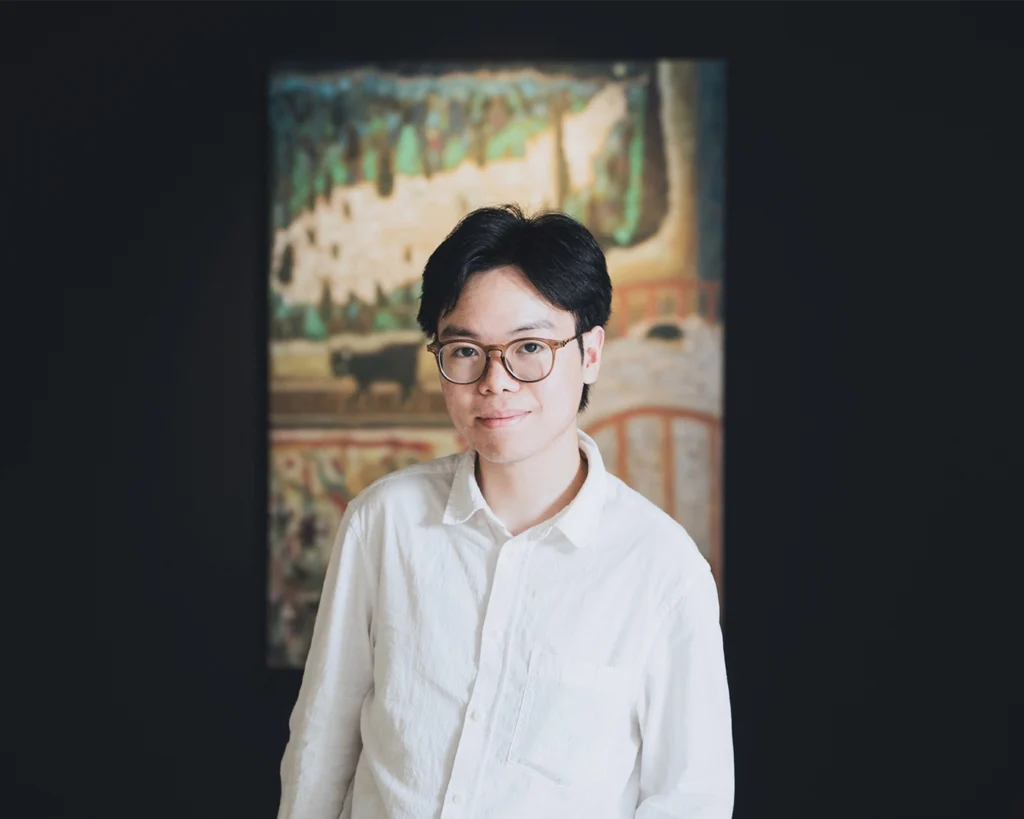
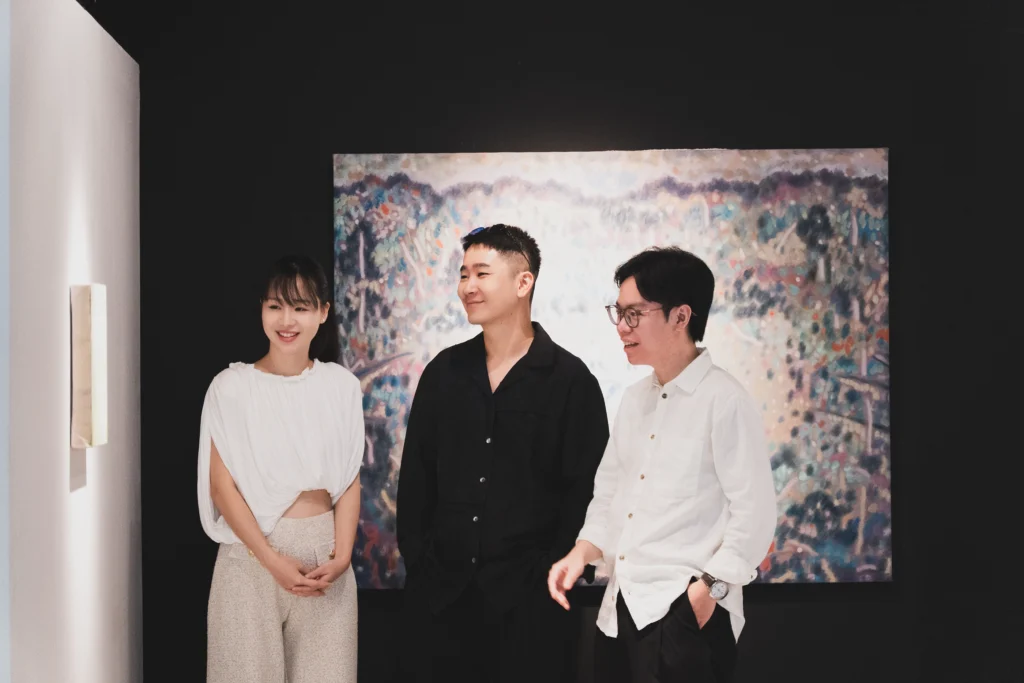
At 23, Hai Hoang has only just begun his artistic trajectory, yet the foundation has been laid with remarkable resolve. A 2025 First Class graduate of Kingston School of Art in London, his output during this period earned him a nomination for the “Freelands Painting Prize” – a distinction given by the Freelands Foundation to recognise exceptional work of graduating students across United Kingdom’s fine arts institutions. Having achieved the milestone of a first solo exhibition at the age of 18 with “Glassy Figures” (2021) in Hanoi, Hoang now returns with his second solo exhibition “Intermission – Nơi này…nơi kia” in early 2026, a project brought to fruition through the patronage and partnership of Gate Gate Gallery.
Studying and practicing art in London, Hoang found himself at home among the humanist traditions that underpin the arts education here at large. It was during these years that he committed his focus to fostering dialogue on issues of memory, and by extension, of heritage – on both individual and public registers. Such contemplations have since quietly
permeated his formal landscapes, settling into a visual language laden with meaning and referentiality.
The ellipsis between ideal and reality
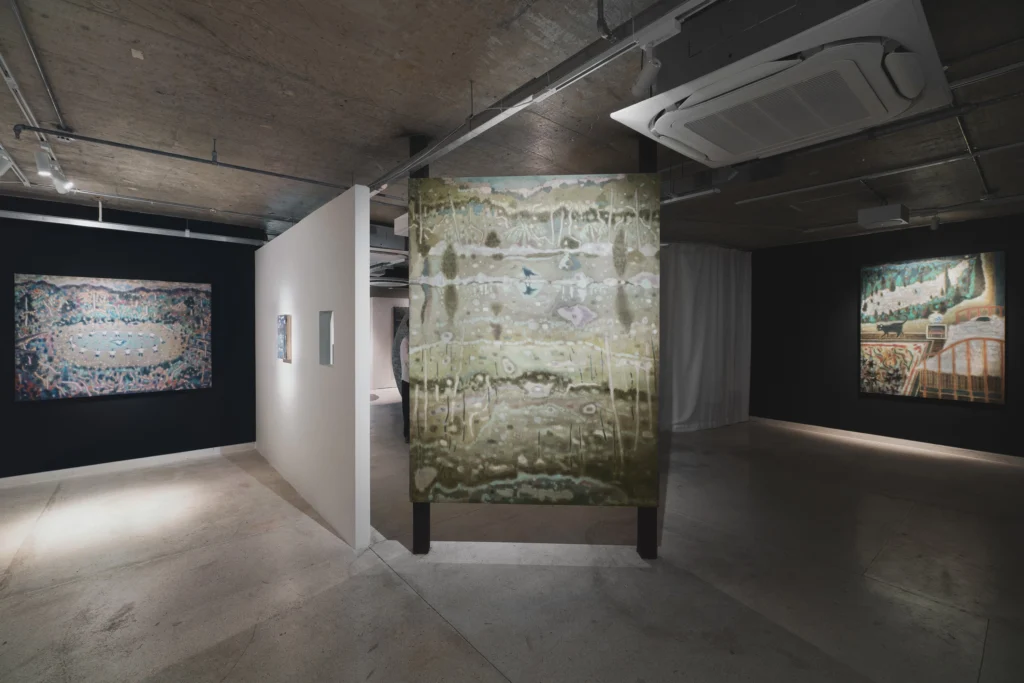
Upon entering “Intermission – Nơi này…nơi kia,” the silence held within the titular ellipsis becomes a necessary condition that allows for an interior shift in the landscape of the mind.
At first glance, the surrealist images, nostalgic palettes, and recurring imperfect symmetries briefly suggest an escape from reality, a longing for some promised land. However, utilising the gazes of the portrayed subjects, the artist subverts this expectation and redirects the viewer towards more intricate questions regarding the workings of memory and the self.
Citing Sigmund Freud as an influence on his own creative thinking, Hoang bifurcates, fragments, and stratifies the perspectives in his paintings. The effect is an echo of the Freudian Uncanny, marked by the recurring motif of the double, a feature central to the psychoanalyst’s work. Beyond dreamscapes, ordinary objects such as water’s surfaces, a door frame, or the trunk of a tree, alongside common yet intimate gestures like a penetrating gaze or an embrace, all become portals through which the subject steps into another position, another psyche, alien yet homely, like the return of a long-buried memory or a primordial self.
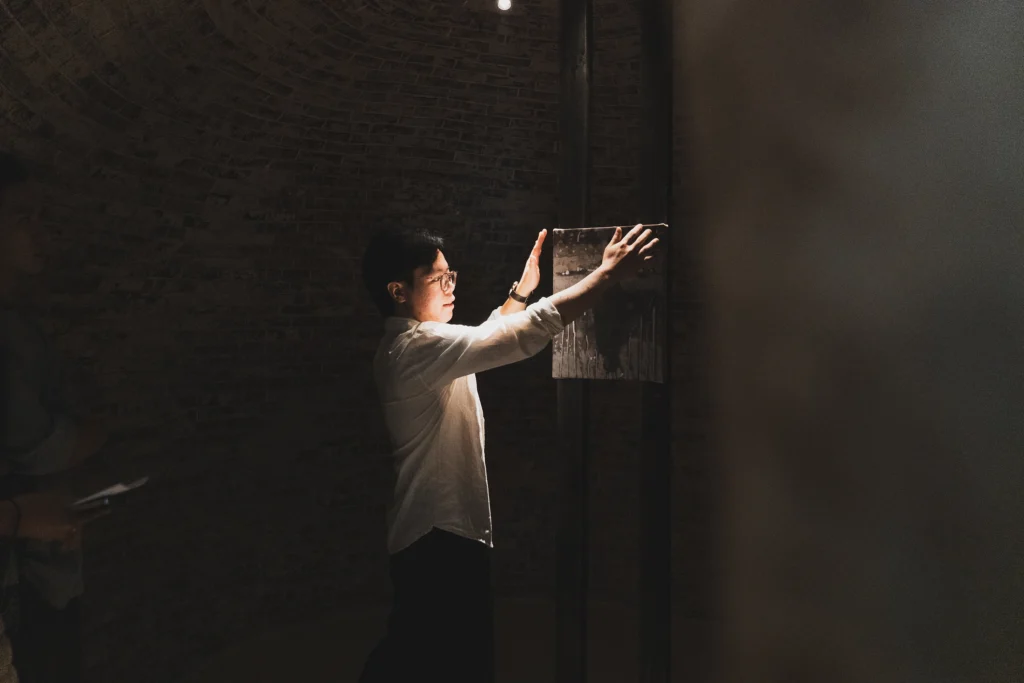
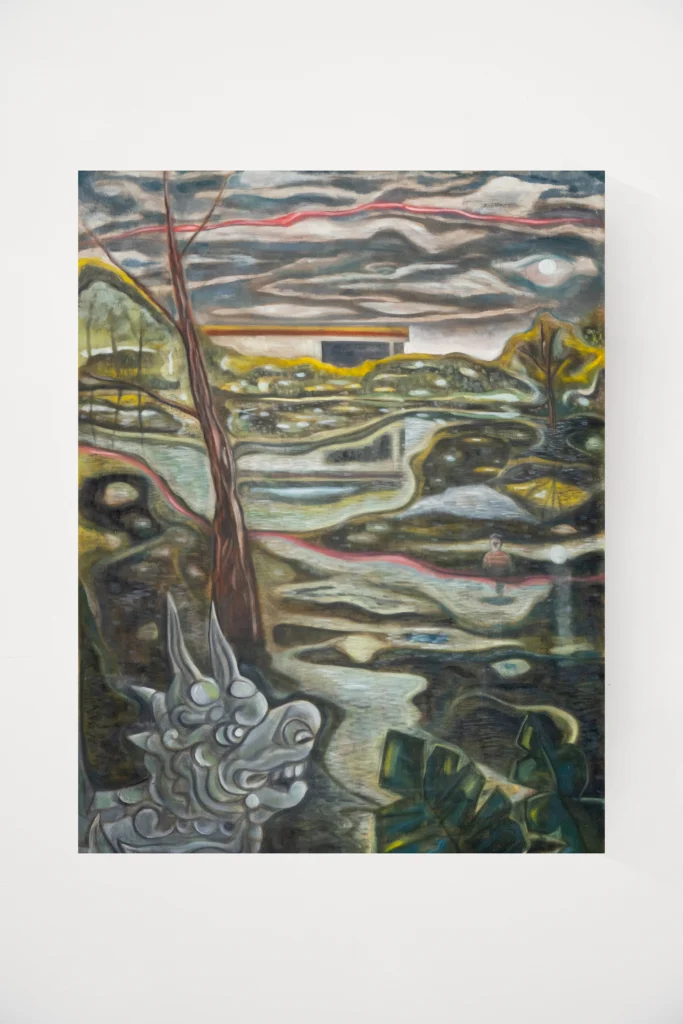
“Swamp,” in particular, establishes its perspective by aligning the viewer’s gaze with the Vietnamese unicorn – a mythical creature of indigenous folklore – locking its questioning eyes with the human figure partially obscured by the hazy sheen of the distant marsh. If the Freudian influence is an easily discernable thread running through Hoang’s body of work, it is the subtle markers of a decolonial consciousness that truly expands his work’s dimension.
In foregrounding a figure of traditional Vietnamese culture as the point of projection, the work achieves a symbolic homecoming, a gripping reckoning with notions of heritage and rootedness from the perspective of an artist away from his motherland. Hoang’s work reveals an artist unafraid of long sojourns across physical and mental boundaries – straddling East-West symbolism, theory and practice, collective intermingling and lonesome introspection.
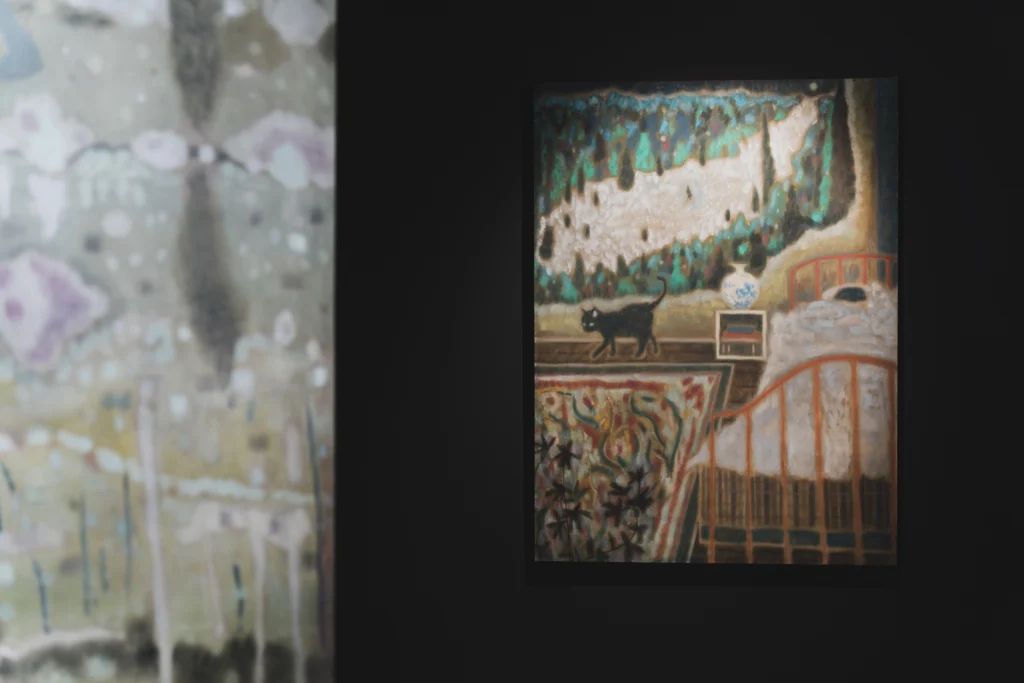
A prominent feature in his practice is the fusion of Eastern imagery, such as the aforementioned Vietnamese unicorn in “Swamp” or the blue-and-white ceramics placed on the bedside table in “Dream,” with Western archetypes of the sacred and the liminal, evidenced by his portrayals of animals believed to harbor psychic resonances, like the raven in “Homesick” and “Lonely Child,” or the black cat in “Dream.” Such synthesis unveils a nimble, expansive referential plane that informs his eclectic language of expression, weaving a cohesive alignment between conceptual breadth and visual manifestation in a way that speaks to his deft formal command.
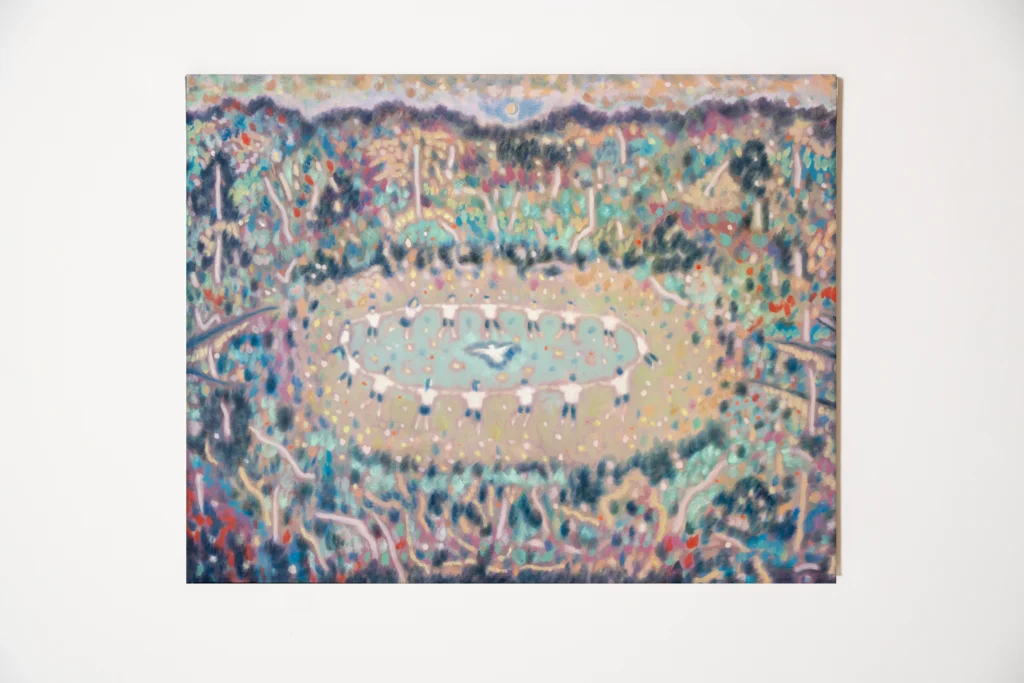
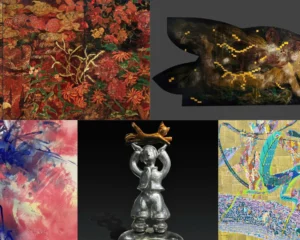
In regards to technique, Hoang employs oil paint diluted with turpentine and oil-based mediums, a method that accelerates drying and allows for the construction of the deeply layered landscapes of his subjects. His fluid brushwork gives rise to a series of overlapping washes and bleeds that recall the dusky state between dreaming and wakefulness. With an overall low-contrast palette, even the more vibrant hues of yellow, pink, and orange are rendered with a certain sombre restraint against darker tones, resulting in a composition that feels solitary, at times haunting and claustrophobic. Each painting conjures a dim, recessed chamber of the mind, captured as lines, shapes and images emerge upon the surface of intuition.
Painting as a persistent act of inquiry
Materialised through a cross-border collaboration between Gate Gate Gallery in Vietnam and the New York-based curator Nguyen Vu Thien An (Thea), “Intermission – Nơi này…nơi kia” marks a pivotal turn in Hai Hoang’s practice and stands as a testament to his commitment to a rigorous, long-term artistic pursuit. Within this space, Hoang establishes an intricate system of narrative symbols, through which he conveys overarching existential meditations born from prolonged introspection.
Despite the nostalgic haze that cloaks his work, Hoang rejects the notion of art as something merely “to be shrouded in mystery and romanticisation.” Behind this friction between illusion and reality is an artist relentlessly in search of ways to look and to find release through the instruments of his art. And yet, even though Hoang deems reality the ultimate answer for his preoccupations, it is in the repose between these paintings that the dream proves to be the most lucid place of all.
“Intermission – Nơi này…nơi kia” is on display from March 12,
2026 to May 03, 2026 at Gate Gate Gallery, 230/18 Pasteur,
Xuân Hòa Ward, HCMC.